
Ryukyu Religion
On the islands of the Ryukyu Archipelago, spirituality was never divided from daily life. It is not a doctrine or a set of commandments. It is a relationship between people, land, ancestors, and unseen beings. What is often called Ryukyuan religion is better understood as a way of life, a memory kept alive through ritual, through stones and trees, and through the breath of prayer that links the living with the spirit world.
The Language of Prayer
The sacred vocabulary of the islands expresses the movement of prayer from inner feeling to spoken reverence. Three words — umui, ogami, and utōtō — describe this rhythm of devotion.
Umui (ウムイ) refers to the inward intention of prayer. It is the heartfelt awareness that connects thought and spirit. Every act of worship begins here, within quiet reflection.
Ogami (拝み) or ugami (ウガミ) names the act of prayer itself. It includes bowing, clapping, lighting incense, and making offerings. This is prayer in motion, the visible form of reverence.
Within this act, one often speaks utōtō (ウートゥートゥー) — a word of deep respect voiced during or at the close of prayer. It is an invocation that acknowledges the sacred presence being addressed. When said with the polite suffix sabira, as in utōtō sabira, it means “I offer reverence.” The word does not signify the whole prayer but serves as a vocal seal of devotion.
Together these three — umui, ogami, and utōtō — describe the complete gesture of Ryukyuan spirituality: the intention, the act, and the voice of offering.
This living faith is believed to move most strongly through women, who hold the roles of mediators and caretakers of ancestral connection.
The Role of Women: Noro and Yuta
In pre-colonial Okinawa, spiritual authority belonged to women. The most revered leaders are noro (priestesses) and yuta (spirit mediums). The noro guide communal life, tending sacred sites and leading ceremonies that renew balance between heaven, earth, and the ancestral realm. The yuta serve as interpreters of the unseen, offering counsel, divination, and healing.
Their roles are inherited or divinely called, often through ancestral lineage. Each embodies the belief that sacred power flows through blood and memory rather than institution.
Sacred Geography: The Utaki
Rather than temples or churches, the Ryukyuan sacred landscape is composed of utaki: groves, rock formations, and caves that serve as dwellings for spirits and ancestors. Each village maintains its own utaki, tied to local myths and family origins.
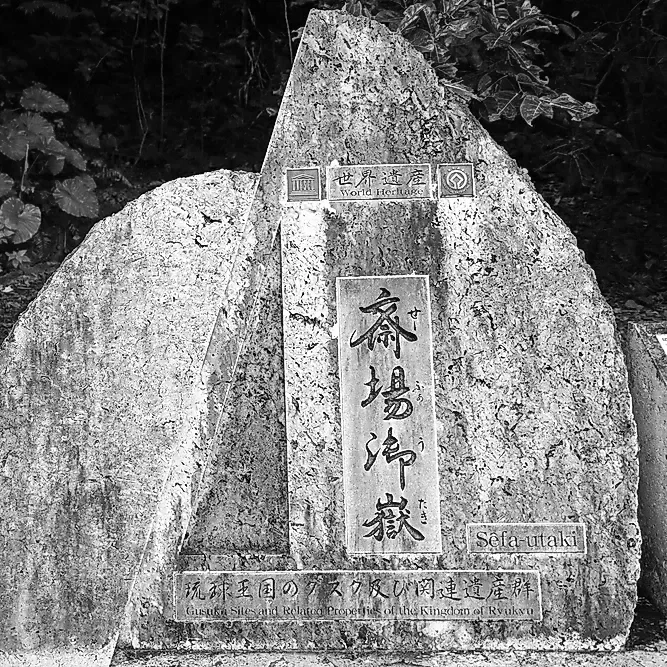
Among them, Sefa Utaki remains one of the most revered. It is said to be the place where Amamikyu descended to form the islands. To step into such a space is to enter the living presence of creation, where land itself is the altar.
Ancestor Veneration and Daily Devotion
Ancestral reverence is the pulse of Ryukyuan spiritual life. Every home keeps a butsudan, an altar where family members offer incense, tea, food, and prayer. Ancestors are companions who protect and guide the living. Seasonal observances such as Obon and Shimi invite families to visit graves, share food, and speak to their departed loved ones. Life and death form one circle of care.
Spirit, Health, and Harmony
Illness or misfortune is often understood as spiritual imbalance, a disturbance between a person, their family, or the land. The yuta act as healers, diagnosing these disruptions and guiding rituals of purification (harae) or reconciliation that restore balance. Wellbeing depends on harmony between body, heart, and spirit.
Living Tradition
The spiritual life of the Ryukyus endures in the rhythm of umui and utōtō, in the breath of daily offerings, and asks for attention and care.
How does the spiritual inheritance of your ancestry live through your daily gestures of care, gratitude, and remembrance?
May your feet remember the path of your people,
May your breath carry the songs of those who still walk with you, unseen.
May your home be a shrine of love and continuity.
And may your own heart be a sacred utaki,
Where each offering honors The Gods.
-Jade
