
A Comparison of Okinawan and Japanese Traditional Foodways
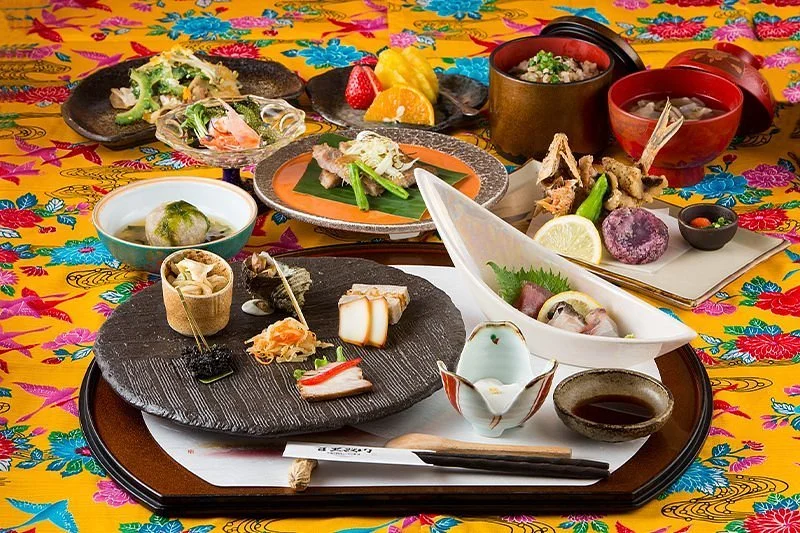
Foodways tell the story of who we are. They carry climate, trade, philosophy, and memory in every bite. Okinawan cuisine grew from the subtropical land and sea, influenced by centuries of exchange with China and Southeast Asia. Japanese cuisine followed its own development, shaped by agrarian rhythms, aesthetic refinement, and courtly ritual. Side by side, they reveal two distinct culinary systems, each carrying a different cultural identity.
Okinawan Court Cuisine vs. Japanese Court Cuisine
At Shuri Castle, court banquets were modeled on Chinese tributary forms. Meals centered on pork, tofu, fish, seaweed, and medicinal herbs, reflecting the philosophy of kusuimun — food as medicine. Dishes nourished the body and displayed the kingdom’s refinement in diplomacy.
In Kyoto, Japanese court cuisine developed into kaiseki and honzen ryōri, emphasizing harmony, aesthetics, and symbolic order. These meals embodied restraint and seasonal beauty, a philosophy rooted in the tea ceremony and elite dining.
Okinawan Everyday Foodways vs. Japanese Everyday Foodways
For Okinawan households, meals were shared communally. Sweet potatoes sustained the population for centuries, complemented by pork broths, seaweed, and foraged greens. The guiding belief was nuchi gusui — life is medicine — so daily meals were prepared to strengthen vitality and extend life.
In Japan, everyday meals followed the structure of washoku: rice or millet, miso soup, and simple side dishes. Fish or meat was eaten less often, and meals reflected agrarian rhythm. The model of harmony and balance was present, but the daily diet was modest in comparison to court ideals.
Japanese Culinary Styles in Okinawa
As Okinawa was absorbed into the Japanese state, different culinary systems arrived from the mainland. Each carried its own philosophy and form. Some were woven into island kitchens, while others remained distant from local life.
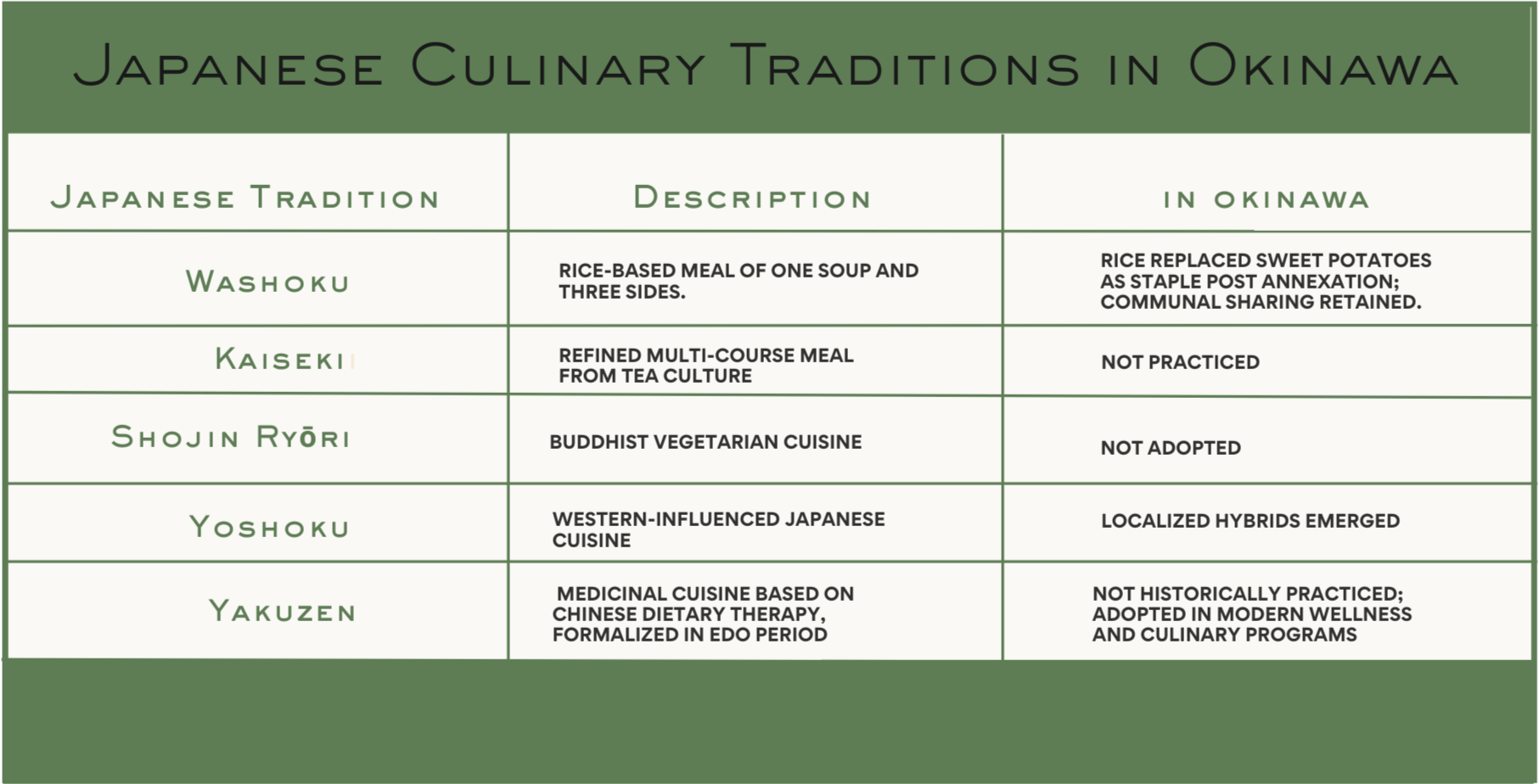
Washoku introduced rice and miso soup more firmly into the daily diet. Yet even with these changes, Okinawan meals kept a family-style rhythm rather than the tray-based structure common in Japan. Miso itself was adapted, often seasoned with pork, showing how new ingredients were reshaped by island taste.
Shojin Ryōri, the vegetarian cuisine of Buddhist temples, found little place in Okinawa. Pork remained central to nourishment, and the philosophy of abstention was not a guiding principle of island cooking.
Kaiseki and Honzen Ryōri, the refined ceremonial cuisines of Kyoto and the samurai class, were likewise not practiced. Okinawa already held its own courtly food culture shaped by Chinese banquet forms and medicinal philosophy.
Yoshoku, Western-influenced Japanese food, arrived through both Japan and the U.S. bases after the war. Here Okinawa created its own expressions — taco rice, Spam champurū, and hambāgu plates — meals that carry the layered story of occupation and adaptation.
Yakuzen, Japanese medicinal cuisine rooted in Chinese dietary therapy, was not a historical tradition in Okinawa. The Ryukyu court instead produced the Gozen Honzō (1830s), a text cataloguing the medicinal properties of local foods, showing that food-as-medicine was already present in a distinctly Okinawan form. Today, “yakuzen” language appears in wellness programs and restaurants, yet the indigenous philosophy of nuchi gusui — life is medicine — remains the living heart of Okinawan foodways.
Okinawan foodways are distinct. They reflect a kingdom shaped by maritime exchange, a worldview that food is medicine, and a communal rhythm tied to land and ancestors. Japanese foodways reflect a different lineage, centered on aesthetics, ritual form, and agrarian balance. Both are rich traditions, but Okinawan cuisine carries its own voice, one that continues to adapt while holding fast to its heart.
References
Takagi, Rin. Traditional Cuisine of the Ryukyu Islands. Naha: Okinawa Times, 1983.
Gozen Honzō, 1830s Ryukyu Royal Court Text.
Rath, Eric C. Food and Fantasy in Early Modern Japan. University of California Press, 2010.
Ishige, Naomichi. The History and Culture of Japanese Food. Routledge, 2001.
Cwiertka, Katarzyna J. Modern Japanese Cuisine: Food, Power and National Identity. Reaktion Books, 2006.
Hoskins, Janet. Okinawan Diaspora and Foodways. American Anthropologist, 2009.
